
HIV Exposure in Dubai: The First 72 Hours
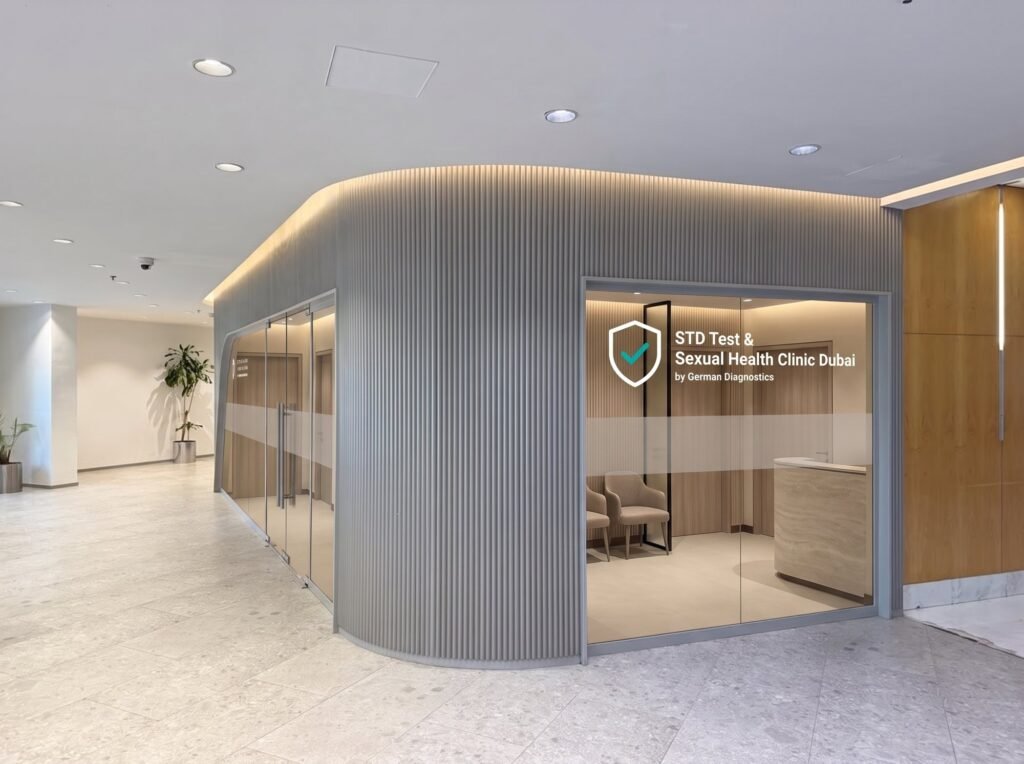
Condomless sex, a broken condom or a needle injury in the last 72 hours? A doctor at our clinic in Dubai Healthcare City assesses your HIV risk, tests you the same day and refers you for HIV post-exposure prophylaxis (PEP) when you need it.
PEP starts as soon as possible after the exposure, ideally within 24 hours.
- Doctor-led risk assessment
- Same-day HIV and STD testing
- Open every day, 07:00 to 23:00
In short
- HIV post-exposure prophylaxis (PEP) starts within 72 hours of the exposure, ideally within 24 hours, and runs as a 28-day course of HIV medicines.
- PEP is approved in the UAE and given on prescription through hospital infectious diseases services.
- At STD Clinic Dubai a doctor assesses the exposure, tests you for HIV, hepatitis B and C and other STDs on the same day and arranges your referral for PEP.
- Condomless receptive anal sex carries the highest sexual risk: about 138 in 10,000 exposures to a partner with HIV, roughly 1 in 72.
- Follow-up HIV tests at 4 to 6 weeks and at 3 months after the exposure show whether an infection happened.
Do you need PEP after a possible HIV exposure?
PEP is considered when an exposure with a substantial HIV risk happened less than 72 hours ago. Exposures with a substantial risk are condomless anal or vaginal sex, a condom that broke or slipped, shared needles and blood on broken skin, with a partner who has HIV or whose HIV status is unknown. These criteria follow the 2025 PEP guidance of the US Centers for Disease Control and Prevention (CDC).
When the HIV status of the partner is unknown, the doctor weighs how likely an HIV infection in the partner is, for example a partner who injects drugs, sells sex or comes from a region with many HIV cases, together with other risk factors such as genital ulcers.
Kissing, saliva, biting, spitting and sharing sex toys carry a negligible HIV risk. In studies of sexual transmission, a partner with HIV who takes treatment and has a viral load below 200 copies per millilitre did not pass on HIV.
How high is the HIV risk of one exposure?
The table lists the estimated HIV risk of a single exposure to a partner with HIV who takes no treatment, without a condom and without PEP, from the CDC HIV Risk and Prevention Estimates.
| Exposure | Risk per 10,000 | In plain numbers |
|---|---|---|
| Receptive anal sex | 138 | about 1 in 72 |
| Insertive anal sex | 11 | about 1 in 900 |
| Receptive vaginal sex | 8 | about 1 in 1,250 |
| Insertive vaginal sex | 4 | about 1 in 2,500 |
| Oral sex | Low | very low |
| Needle-stick injury | 23 | about 1 in 435 |
| Sharing needles for drug use | 63 | about 1 in 160 |
Other sexually transmitted infections, a high viral load in the partner and lack of circumcision raise the risk above these estimates.
What happens at your visit after an HIV exposure
A visit after a possible HIV exposure at STD Clinic Dubai follows 4 steps.
- Risk assessment. The doctor asks when and how the exposure happened and what is known about the partner.
- Baseline tests on the same day. A laboratory HIV antigen/antibody test (fourth generation), hepatitis B and C, syphilis, and chlamydia and gonorrhoea from the throat, genitals or rectum. Women also discuss a pregnancy test and emergency contraception with the doctor.
- Referral for PEP. When PEP is indicated, you leave with a referral to a hospital infectious diseases service. The first PEP dose is not held back for test results.
- Follow-up. Repeat HIV tests at 4 to 6 weeks and at 3 months, and repeat tests for other STDs at the right time.
Baseline tests show your HIV status before the exposure. A test in the first days after an exposure cannot detect an infection from that exposure.

How PEP works and how well it protects
HIV post-exposure prophylaxis (PEP) is a 28-day course of three HIV medicines, taken once a day. One preferred regimen in the 2025 CDC guidelines is a single daily tablet combining bictegravir, emtricitabine and tenofovir alafenamide.
How well does PEP work?
No placebo-controlled trial of PEP after sex exists, so the evidence comes from animal studies, health workers and observational data. In health workers after a needle-stick injury and in pregnant women, PEP with the single drug zidovudine lowered HIV transmission by 70 to 80 percent. PEP today combines three drugs instead of one.
In a study of 24 macaques (monkeys) exposed to a virus closely related to HIV, no infection appeared when PEP started within 24 hours, and protection fell the longer the start was delayed.
PEP is not 100 percent effective. Missed doses, a late start and new exposures during the 28 days are the main reasons PEP fails.
What are the side effects of PEP?
Side effects of current PEP regimens are usually mild, for example nausea, headache and diarrhoea. In a study of 100 people taking tenofovir, emtricitabine and raltegravir for PEP, 85 percent took all or most of the 28-day course. Nausea or vomiting affected 27 percent, about 1 in 4, and diarrhoea 21 percent, about 1 in 5. Nobody stopped PEP because of side effects.
Kidney and liver values are checked before PEP starts, because tenofovir can rarely affect the kidneys.
What about hepatitis B?
Hepatitis B has its own protection after an exposure. People without hepatitis B immunity receive the hepatitis B vaccine, and sometimes hepatitis B immune globulin (HBIG, ready-made antibodies), ideally within 24 hours and up to 14 days after a sexual exposure. Hepatitis C has no preventive treatment, so follow-up tests detect it early.
What if exposures happen again?
People with repeated exposures discuss pre-exposure prophylaxis (PrEP), HIV medicines taken before sex, with their doctor, because PrEP avoids repeated PEP courses.
When an HIV test can detect infection after an exposure
A laboratory HIV antigen/antibody test (fourth generation) detects most infections 18 to 45 days after the exposure. An HIV RNA test, which looks for the virus itself, detects infection after 10 to 33 days. Rapid finger-prick tests take 18 to 90 days, so a negative rapid test soon after an exposure does not rule out HIV.
The table lists how many days after infection each HIV test usually turns positive, from HIV.gov.
| Test | What it detects | Turns positive after |
|---|---|---|
| HIV RNA test (nucleic acid test) | The virus itself | 10 to 33 days |
| Laboratory antigen/antibody test (fourth generation) | p24 antigen and antibodies | 18 to 45 days |
| Rapid antigen/antibody test (finger prick) | p24 antigen and antibodies | 18 to 90 days |
| Antibody-only test | Antibodies | 23 to 90 days |
After an exposure, HIV tests take place at 4 to 6 weeks and again at 3 months, each with an antigen/antibody test and an HIV RNA test, as in the 2025 CDC guidelines. An antigen/antibody test before day 28 is not used on PEP, because PEP can hide an early infection.
Which symptoms need an HIV test at once?
Acute HIV infection often causes symptoms 2 to 4 weeks after the exposure. In five studies of 378 people with acute HIV, the most common symptoms were fever in 75 percent (3 in 4), tiredness in 68 percent, muscle pain in 49 percent, skin rash in 48 percent and headache in 45 percent. These symptoms after an exposure are a reason for an HIV test straight away, including an HIV RNA test.
What happens until the last test?
Until the 3-month test, guidelines advise condoms for sex and no shared needles, because most people who acquire HIV test positive within 12 weeks. Donating blood, plasma, organs or semen waits 12 months after the exposure.
Tests for chlamydia, gonorrhoea and syphilis follow their own windows, explained on our page about STD testing in Dubai.
PEP and HIV testing in Dubai and the UAE
Is PEP available in Dubai?
Yes, PEP is available in Dubai on prescription. The UAE Ministry of Health approved antiretroviral medicines for PEP nationwide in 2008 (Gulf News), and PEP is given through hospital infectious diseases services. The Abu Dhabi HIV Management Guideline 2023 names designated infectious diseases clinics for PEP, and in Dubai Rashid Hospital runs an HIV programme. PEP is not sold without a prescription.
STD Clinic Dubai assesses the exposure, runs the baseline tests on the same day and refers you to a PEP service.
Is HIV testing in Dubai confidential?
HIV testing at STD Clinic Dubai is confidential: your results are filed under a patient ID number and shared only with you. HIV testing in the UAE is not anonymous. Federal Law No. 14 of 2014 on communicable diseases requires doctors and laboratories to notify the health authority of a confirmed HIV infection.
Frequently asked questions about HIV exposure in Dubai
Short answers about PEP, HIV tests and confidentiality in Dubai.
Yes. PEP is available in Dubai on prescription through hospital infectious diseases services. STD Clinic Dubai assesses the exposure, runs baseline tests on the same day and refers you for PEP.
PEP starts as soon as possible, ideally within 24 hours and no later than 72 hours after the exposure. After 72 hours PEP is usually not started, and follow-up HIV testing takes its place.
No. An HIV test in the first days after sex shows your status before the exposure. A laboratory antigen/antibody test detects most infections after 18 to 45 days, an HIV RNA test after 10 to 33 days.
HIV tests take place at 4 to 6 weeks and at 3 months after the exposure, with an antigen/antibody test and an HIV RNA test. Fever, rash or flu-like symptoms after an exposure are a reason to test at once.
No. PEP lowers the risk of HIV but does not remove it. Missed doses, a late start and new exposures during the 28 days are the main reasons PEP fails.
No. HIV testing in Dubai is confidential but not anonymous. UAE law (Federal Law No. 14 of 2014) requires doctors and laboratories to notify the health authority of a confirmed HIV infection.
See a doctor the same day. A broken condom during anal or vaginal sex with a partner of unknown HIV status is a possible HIV exposure, and PEP is considered within 72 hours. Tests for other STDs are part of the same visit.
Book an urgent visit
Send your name and contact details, and the clinic gets back to you to arrange your visit in Dubai Healthcare City.
Request an appointment
Your details are used only to answer your enquiry.
Related guides
Sources
- Clinical Guidance for PEP (2025), US Centers for Disease Control and Prevention
- HIV Risk and Prevention Estimates, US Centers for Disease Control and Prevention
- HIV Testing Overview, HIV.gov, US Department of Health and Human Services
- Abu Dhabi HIV Management Guideline, Version 1.0 (2023), Department of Health Abu Dhabi, Abu Dhabi Public Health Center
- Sale of drugs to cut HIV infection allowed (2008), Gulf News
- Service Catalogue Rashid Hospital, Dubai Health Authority
- Federal Law No. 14 of 2014 Concerning the Prevention of Communicable Diseases, UAE Ministry of Health and Prevention
- Cardo DM, et al. A case-control study of HIV seroconversion in health care workers after percutaneous exposure. N Engl J Med 1997.
- Tsai CC, et al. Effectiveness of postinoculation (R)-9-(2-phosphonylmethoxypropyl)adenine treatment for prevention of persistent simian immunodeficiency virus infection depends critically on timing of initiation and duration of treatment. J Virol 1998.
- Mayer KH, et al. Raltegravir, tenofovir DF, and emtricitabine for postexposure prophylaxis to prevent the sexual transmission of HIV: safety, tolerability, and adherence. J Acquir Immune Defic Syndr 2012.
- Daar ES, Pilcher CD, Hecht FM. Clinical presentation and diagnosis of primary HIV-1 infection. Curr Opin HIV AIDS 2008.